
 |
| 

FAQ
News | Forum
Visa Selector
Complete List
TN |
 H-1
H-1 | L-1
|
B-1 | E-2
| L-1
|
B-1 | E-2Citizens
Bridge
Links | Handbook

IT Professionals
Construction
Lawyers

Testimonials
Fees | Retainer
Building

Rolodex
Tax
Jobs
Social Security
Moving



Supporting Canadians and Their Employers for Three Decades
H-1B Professional-U.S. Immigration Permit for University Degree Professions; Information for Canadians
You're going to be successful long term if you have good people. ---Archie W. Dunham, Chairman & CEO, Conoco Inc., in Business Week,
Return to the top of this page
 Joseph C. Grasmick |
Introduction to This Web Page
"If you're Canadian and have an H-1, you're probably on the wrong visa."
On this page I describe the "Canadian
twists" to H-1B immigration status. If you are Canadian
or want to hire a Canadian, there are H-1B issues that
pertain just to you. Serious misunderstandings surface
when Canadian citizenship is in the immigration mix.
These issues include the question "I'm on a TN. Do I have to
have an H-1 before I can apply for a Green Card?"
Another example: unbelievably, advisors often tell Canadians to go to the
U.S. Consulate to get an H-1 passport visa! (Canadians do
not need H-1 passport visas.) Scrutiny as to admissibility takes place at the border.
Therefore, knowledge of current Canada-U.S. border procedures is indispensable.
This is why I write this page. Over my decades of
legal practice, countless Canadians have found special opportunities by
taking into account their immigration advantages. This information has
changed lives.
The H-1B covers many
Canadians in a huge spectrum of learned professions.
Nevertheless, before reviewing this page, please consider the easier
B-1 Business Visitor and the TN
NAFTA permits. Also consider the often overlooked L-1
intra-company Transferee
Permit. Before committing to an H-1, consider advantages of other
approaches:
- Timing. Canadians can get these three permits (B-1, TN and L-1) right at the border. (See a photograph of the actual "I-94" card.) In contrast, you must mail H-1 applications to two government agencies and wait.
- Quota lottery. There is a limit on the number of H-1 permits the INS can grant each year. There is no such limit on TN permits. While you might have to wait a year or more with an unclear H-1 outcome, you can get a TN decision at once.
- J-1 holders need not go home first. A TN is available to a J-1 exchange visitor who has not completed the J-1 foreign residency return requirement. (If this pertains to you, you will know what I mean!)
- H-1 and L-1 cap buster. Canadians who have reached their maximum cap on H-1 or L-1 years, can get a TN.
- No license. Requirements for a U.S. professional license may be more lenient under a TN.
- Social responsibility. It helps others to select the TN over the H-1. Overuse of H-1 permits could result in making an H-1 unavailable for someone else.
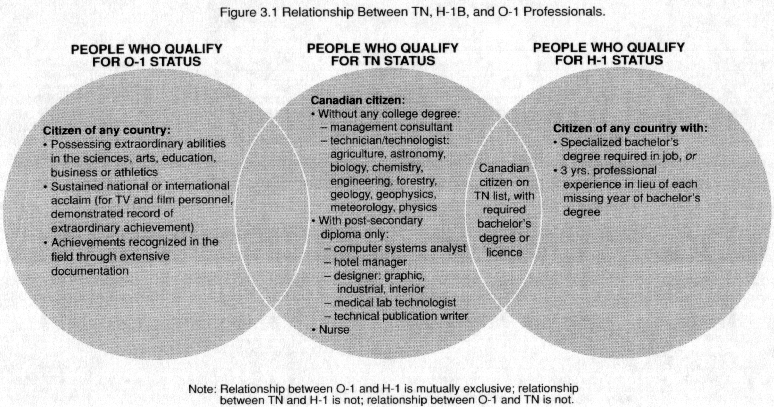
Look at this graphic to see if your profession fits
within the O-1, TN-1 and/or the H-1B. Use this
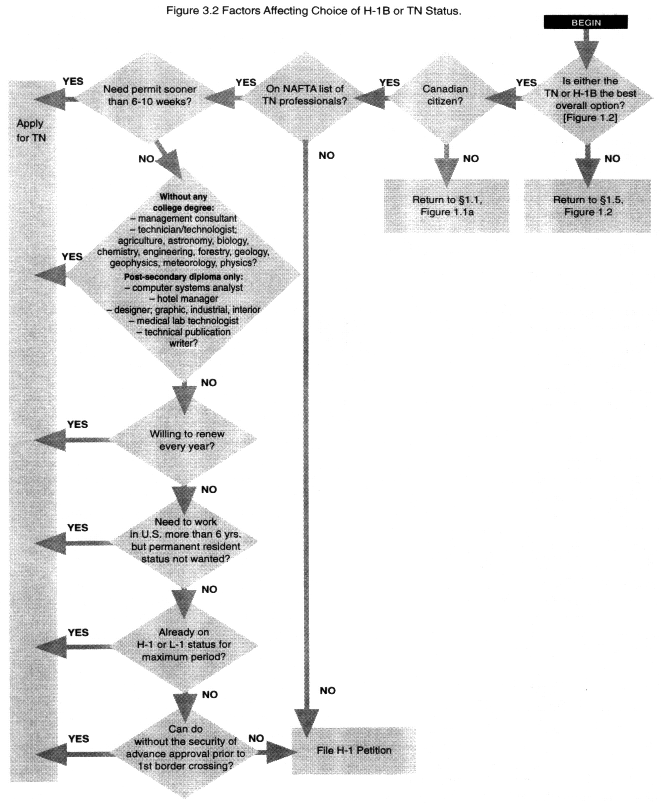
flowchart to decide between the TN-1 and the H-1B.
This is the best starting place on the Internet
for Canadians considering the H-1B. Nevertheless the government
constantly changes H-1 rules. Your lawyer must update you before you go
ahead with the application. If you are considering using my office, I invite you to
read about my office, legal
fees and client opinions. This should help you
make an informed decision.

Return to the top of this page
H-1B Status: Temporary Professional Worker
| Main procedural step: | Send applications to Labor Department and INS first. |
| Initial duration of status: | Three- then three-year extension. |
| Total time-limit on the category: | Six year total time cap. |
| Processing time: | Six-to-ten weeks to approve, then wait for lottery. |
| Major advantage: | Lasts a long time. |
| Major disadvantage: | Much paperwork if professional status not clear. |
Return to the top of this page
Introduction to H-1 Status
The rest of this page details requirements
for H-1 status for professionals in specialty occupations. You can prove
most of the following requirements by information provided in a
covering letter from the company applying for H-1B status (the petitioner)
for the employee (the beneficiary).
Once your petition is
approved, the Canadian beneficiary does not need a passport visa
from the U.S. Consulate. This is a major advantage over citizens of
other countries. The Canadian merely mails in an extension or change
of status application, or picks up the H-1 on form I-94, at the
border.
Return to the top of this page
Requirements for H-1B Status
(i) Must leave the United States when work is complete
| An H-1 employee need not maintain a foreign residence. |
The H-1B non-immigrant category requires an intent
by the employer (the petitioner) and the employee (the beneficiary) that
the placement by temporary. If either side fails to show this temporary
intent, status will be denied. It is not necessary for the actual position
to be temporary: employers need only demonstrate that the placement of the
non-U.S. citizen in that position is to be temporary. Both the Immigration
and Naturalization Service and the State Department recognize a concept
known as "dual intent". You can simultaneously intend to do temporary work
now and at some later date work permanently. An H-1 employee need not
maintain a foreign residence.
Because of Canadians' proximity to
the U.S., frequent trips back home, and ease of maintaining links to
Canada, problems in this area are rare. The absence of
Consular passport visa scrutiny also helps.
(1) Document Necessary to Prove Requirement
Letter from petitioner.
(ii) Must qualify as a professional
(1) Managerial Personnel
Managerial personnel must now show that they qualify as "professionals," (Specialty Occupations, see (2) below). There is no independent means under the H-1 visa to qualify.
This means that business people must show that
their particular specialty normally requires the skills of a university
trained professional. It also means that the business person must have the
degree either through academic study or through carefully defined
alternative work experience (See (2) below).
Similarity between
U.S. and Canadian educational systems is helpful when proving this.
(2) Professionals
TN qualification for professional activities will not necessarily qualify the applicant as an H-1B professional. (Conversely, Canadians qualified for H-1B status may not necessarily qualify for TN status.)
To qualify in the H-1B professional category, both the beneficiary and the position must be professional in nature. The law defines a profession as a specialty occupation that requires the critical and practical application of a body of highly specialized knowledge. It lists a number of areas in which a professional might be employed, including:
- Accounting
- Architecture
- Arts
- Business Specialties
- Design
- Education
- Engineering
- Law
- Mathematics
- Medicine and Health
- Physical Sciences
- Social Sciences
- Theology
Case
A U.S. corporation wishes to employ a Canadian citizen for a high-level position. However, the position is not in a business specialty recognized by the INS.
Solution: Show that the particular position is so complex that it requires the services of a person possessing at least a Bachelor's degree. Alternatively, show the position has always been occupied by a person with that degree or similar positions in the industry require such.
(A) Professional with Bachelor's Degree
To be a designated professional, the beneficiary
typically must have completed a specific course of study at an accredited
college or university. That study must have culminated in at least a
bachelor's degree. (I have successfully obtained H-1 status for some
Canadians with 3-year
Bachelor's Degrees.) Finally, such
a degree or its equivalent must be the minimum requirement for entering
the position in the United States. To prove this requirement, at least a diploma
and an evaluation stating the equivalent U.S. degree must be submitted
[
See my Rolodex ].
Technologists
may qualify for the H-1B. This could include engineering
technologists. It may also include some technologists in the medical
professions (e.g., respiratory, ultrasound, radiology, nuclear medicine,
physician assistants area of health care).
(B) Professional without Bachelor's Degree
| Some licensed individuals and people with a certain level of professional experience can overcome the bachelor's-degree requirement. |
Some licensed individuals and people with a certain level of professional experience can overcome the bachelor's-degree requirement by carefully documenting those special qualifications. This documentation must include one or both of the following:
1. An unrestricted licence, registration, or certification authorizing the beneficiary to immediately engage in the profession. Similarities between Canada and U.S. licensing systems can be helpful here.
2. A certain level of education, specialized training, and/or professional experience. This must be equivalent to the training received by bachelor's-degree recipients.
(iii) Must acquire a U.S. licence, if one required by the state in
which employment is located
(iv) Must demonstrate need for high-level employee
(v) Petition must contain a Labor Condition Application approved by the Department of Labor
- The Labor Condition Application for H-1 status is not the same as a Labor Certification for a green card. It is much easier and faster to get. You do not have to place a help wanted ad in the newspaper.
- You do not have to provide supporting documents. You do have to have the supporting documents on file in case you are audited.
- The form is deceptively simple. The Labor Department only "approves" it by checking whether or not you filled out the form correctly. Even so, almost 25% of the applications are denied merely because the form is not filled out correctly. Also, remember that if you are ever audited, you must have had all the supporting documents on file or face penalties.
- An employer can file the application for more than one person at once. If you do this, make sure you have supporting documents on file for all beneficiaries.
| The Labor Condition Application for H-1 status is not the same as a Labor Certification for a green card. It is much easier and faster to get. |
Possible penalties include civil money penalties, payment of back wages to the H-1B, and debarment of the employer from employing foreign workers in the future. As is the case with other government forms, intentional misrepresentation can result in criminal perjury sanctions. The message: employers should make sure that their files are complete and updated.
On the Labor Condition Application Form, the employer makes four important statements. For each statement, the employer must immediately have supporting documents in its files.
Here is a summary of the four required statements with examples of required documents for employers' files:
(1) Salary Must Not Undercut U.S. Workers' Salary
The salary offered the H-1B beneficiary must be at least the greater of one of the following:
- the actual salary paid to everyone at the proposed work site working at substantially the same job, with similar qualifications and experience, or
- the prevailing salary for the job in the work site's geographical area.
If there are no other people working at substantially the same job, the actual salary figure will be the salary figure the employer pays the beneficiary.
The salary must exceed minimum Federal, State and local wage requirements.
(A) Documents Necessary to Have in Your Files to Prove Requirement
It is not difficult to show that the beneficiary's salary matches or exceeds the salary of present employees. Have this in your files for every employee with qualifications and job experience even slightly similar to the beneficiary:
- full name
- home address
- occupation
- rate of pay
- hours worked each day or week
- additions/deductions to pay
- total wages paid
| If audited, the burden will be on the employer to demonstrate the legitimacy of the information. |
It is more difficult to show that the salary is prevailing for the job in the area. You can show a prevailing salary in one of five ways. The first four are "safe harbors"; you are safe if you use the first four documents. The fifth way is acceptable, but if audited, the burden will be on the employer to demonstrate the legitimacy of the information.
- Wage determination published under requirements of the Davis-Bacon Act. These are available in public libraries or through the State Employment Security Agency (SESA). [For the relevant State Employment Security Agency, contact the regional office of the Department of Labor, Appendix A.7.] A safe harbor, but not likely your occupation, is covered in these surveys.
- An arm's-length union contract, if the job is unionized. A safe harbor.
- A customized State Employment Security Agency salary survey . Request, in writing, from the State Employment Security Agency with jurisdiction over your area. If you are unable to wait for the determination, order it, and rely on other legitimate source of wage information in the meantime [See below]. Even if the subsequent SESA survey is higher, this is still a safe harbor if the employer retroactively compensates the H-1 for the difference.
- A survey conducted by an independent authoritative source. This must be published in a book, newspaper, periodical, loose-leaf service, newsletter or other similar medium within the 24-month period preceding the filing. It must be published by an organization with a recognized expertise in the field. It can be a professional, business, trade, educational or governmental association, organization, or other similar entity, not owned or controlled by the employer. This is a safe harbor. The salary can be up to 5% lower than the survey figure.
- Another legitimate source of information. This is probably the method most of the readers will use, but not a safe harbor. Useful when you are certain the salary is well above prevailing. You can have a professional do the salary survey for you [See my Rolodex]. The salary can be up to 5% lower than the survey figure.
The prevailing salary data must survey jobs requiring a substantially similar level of skills. It must survey salaries within the geographical area of intended employment. This geographical area is the area within normal commuting distance of the place of employment. Use a Metropolitan Statistical Area to define normal commuting distance. If there are no such jobs in the area of intended employment, you can look at areas outside the area of intended employment.
The employer must get a new copy of prevailing salary information every 24 months throughout the period of employment of the H-1 beneficiary. This period runs from the date the labor condition application was approved. The employer must adjust the rate of beneficiary's pay upwards if the prevailing rate exceeds beneficiary's actual pay.
Pay close attention to the 24-month requirement. You will not get a reminder. Although your labor condition application may be valid for up to 6 years, you must update the wage survey every 24 months.
Remember, you must have data showing both the salary actually paid to employees and the prevailing salary. This is because the employer must pay the greater of the two figures.
(2) Beneficiary Will Not Hurt Working Conditions for U.S. Workers
Hiring the H-1B cannot hurt the hours, shifts, vacation periods and fringe benefits of other U.S. workers.
(A) Documents Necessary to Have in Your Files to Prove Requirement
There are no clear rules. Examples include published studies, surveys or articles regarding working conditions at your work site. Fringe benefit packages, and office policy manuals which pre-existed the employment of the H-1B, are additional examples.
(3) No Strike or Lockout
There can be no strike or lockout from a labor dispute in beneficiary's job at the work site.
(A) Documents Necessary to Have in Your Files to Prove Requirement
In the case of an investigation, the employer will have the burden of proof in showing that there were no relevant labor problems in the job classification. While the current laws do not require the employer to maintain documents, the best precautionary approach is to maintain records on prevailing and actual wages for at least a one-year period after the end of the beneficiary's employment. If the employer withdraws his H-1B application, or if a labor complaint is pending, the employer should maintain such records for a year as well.
(4) Public Notice of Intent to Hire an H-1B
The employer must have publicized the fact that it intends to hire an H-1B. The employer must also publicize certain proposed employment terms for the H-1B. This is so that any interested party can challenge the employer's statements and trigger a Labor Department audit.
The notice can be one of two things:
- communication to the bargaining representative if there is one for the proposed job, or if not
- notices posted in conspicuous locations at the work site
Documents Necessary to Have in Your Files to Prove Requirement
If there is a collective bargaining representative for the job, keep a copy of a letter or notice sent to the representative. If there is no such representative, your files should have two notices posted for at least 10 days. I suggest 14 consecutive business days to avoid mistakes. Post the notice in two conspicuous places at the prospective work site.
Return to the top of this page
|
Search | Home & Contents | FAQ | News | Order Handbook | E-mail
Law Office of Joseph C. Grasmick, Business Immigration 300 International Drive Williamsville, NY 14221 USA Tel: 716/842-3100 jgrasmick@grasmick.com |